Flash Sale - Get 10% Off All Products With Code NOW10
If you are new to electric vehicles, one of the first things you will notice is that not all EV charging connectors look the same. The two most common charging connector types are: Understanding the difference is important because EV charging cables are not interchangeable. Fortunately, once you understand the basics, Type 1 and Type […]
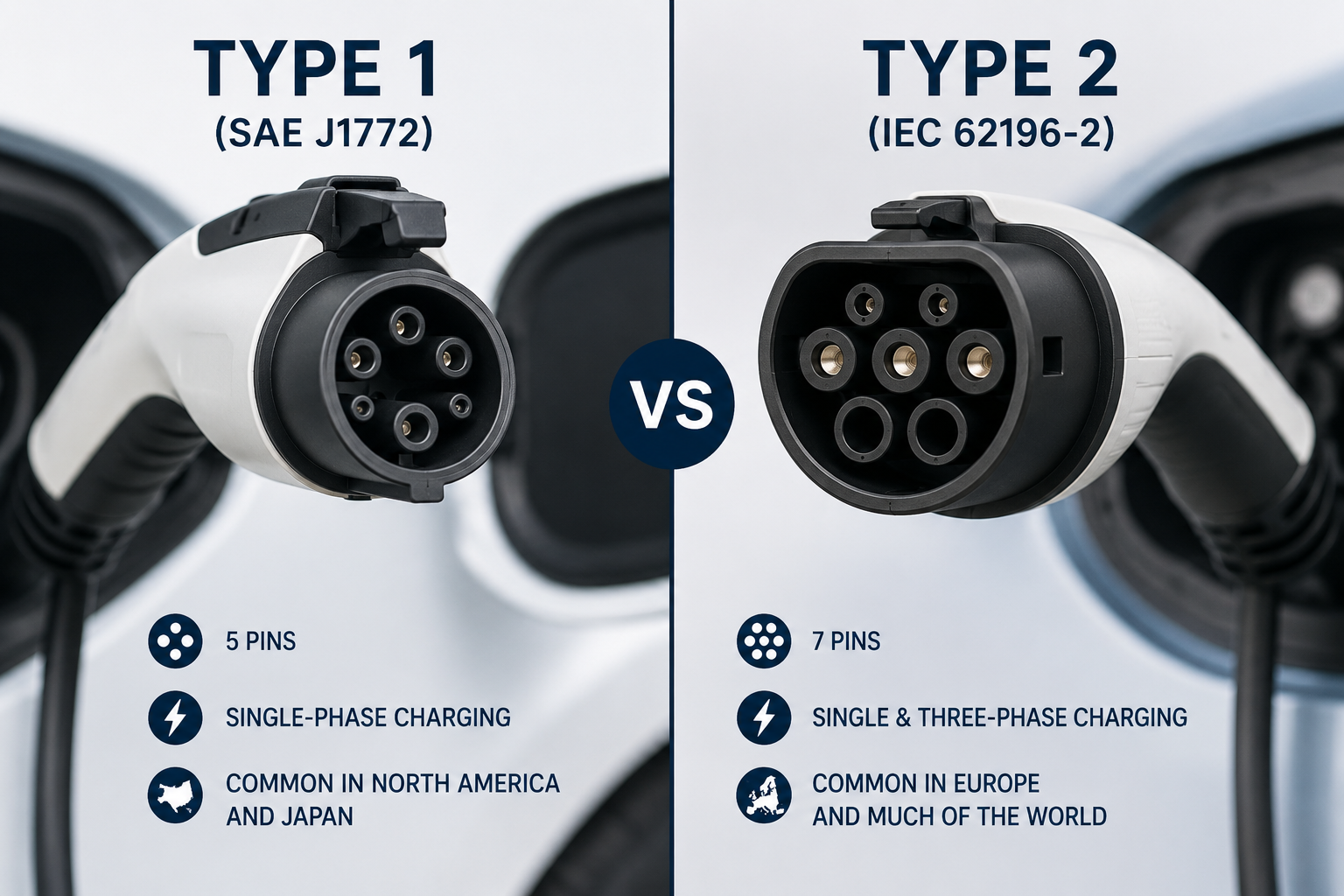
If you are new to electric vehicles, one of the first things you will notice is that not all EV charging connectors look the same.
The two most common charging connector types are:
Understanding the difference is important because EV charging cables are not interchangeable.
Fortunately, once you understand the basics, Type 1 and Type 2 charging systems are fairly straightforward.
A Type 1 connector is an older EV charging standard primarily associated with:
Type 1 connectors are also commonly referred to as:
They are widely used in:
Type 2 is now the standard EV charging connector used across most modern EVs in the UK and Europe.
It is commonly found on:
Type 2 connectors are sometimes referred to as:
Today, Type 2 has become the dominant AC charging standard across Europe.
The connectors are physically different.
Type 1 connectors:
Type 2 connectors:
The two connector types are not directly interchangeable without appropriate adaptors.
Type 2 became the European standard because it supports:
As EV adoption increased, standardisation became increasingly important for:
Today, nearly all new EVs sold in the UK use Type 2 charging for AC charging.
Some older EVs and plug-in hybrids still use Type 1 connectors.
Examples may include older versions of:
However, manufacturers have gradually moved toward Type 2 across European markets.
Most modern EVs in the UK now use Type 2 connectors for AC charging.
Examples include:
Type 2 compatibility is now extremely common across both home and public charging infrastructure.
Potentially, yes.
One major advantage of Type 2 is that it supports:
This allows for greater charging flexibility and potentially faster AC charging speeds.
However, actual charging speed still depends on:
Sometimes, yes.
Many public charging points in the UK have Type 2 sockets rather than permanently attached cables.
If your vehicle uses Type 1, you can often use:
This allows a Type 1 vehicle to connect to a Type 2 charging station.
Adaptors exist for some situations, but compatibility depends on:
For regular charging, it is usually better to use the correct dedicated charging cable where possible.
Rapid charging is slightly different.
Many rapid chargers use separate DC connector systems such as:
These systems bypass the vehicle’s onboard AC charger and are separate from standard Type 1 and Type 2 AC charging discussions.
However, most everyday home and destination charging still relies heavily on Type 2 infrastructure in the UK.
Not entirely, but it is becoming less common in Europe.
Drivers with Type 1 vehicles can still charge successfully using compatible cables and charging stations.
However:
For this reason, Type 2 is generally considered the long-term standard for UK EV charging.
The correct cable depends entirely on:
Most modern UK EV owners need:
Owners of older Type 1 vehicles often need:
Before buying, always check:
When selecting an EV charging cable, consider:
A good charging cable should be durable, reliable, and suitable for long-term outdoor use.
Understanding the difference between Type 1 and Type 2 EV charging cables is an important part of owning an electric vehicle.
While Type 1 connectors are still used on some older EVs, Type 2 has become the dominant charging standard across the UK and Europe.
For most modern EV owners:
Choosing the correct charging cable helps ensure safer, faster, and more convenient charging both at home and on the road.
Type 1 connectors are older 5-pin connectors mainly found on older EVs, while Type 2 connectors are the modern European standard used on most new EVs.
Yes, with the correct Type 2 to Type 1 charging cable.
Type 2 systems can support higher charging power and three-phase charging, depending on the vehicle and charger.
Most modern UK AC charging infrastructure uses Type 2 connectors or sockets.
You can check: